Superstitious Obsessions
Religious Obsessions in OCD
Obsessive-compulsive disorder can cause a crisis of faith.
Ghazel Tellawi, Ph.D.

Religious OCD Subtype
Common Obsessions About Religion
- Concerns with sacrilege or blasphemy
- Accidentally omitting any loved ones from their prayers
- Worries about inadvertently offending God
- Worries about accidentally worshipping the devil
- Performing a religious task or ritual in the wrong way
- Having committed a sin
- Thinking too much about purity
- Going to hell
- Praying in the wrong way
- Perfectly following scripture or other religious doctrines
- Death
Religious thoughts can become intrusive and distressing in individuals with OCD. These thoughts can involve intrusive religious blasphemous thoughts, compulsive prayers, hypermorality, unwarranted concern about committing a sin, and cleaning/washing rituals (Himle, Chatters, Taylor & Nguyen, 2001). These thoughts sometimes become problematic and are referred to as “scrupulosity.” Scrupulosity describes the relationship between religiosity and the symptoms of OCD, and individuals with these obsessions often focus on certain details of their religion while ignoring others.
One large study found that scrupulous obsessions in OCD were ranked as the fifth most common obsession, with 6% of participants endorsing it as their primary obsession. Additionally, it has been estimated that religious obsessions occur in 25% of individuals with OCD (Antony, Dowie, & Swinson, 1998). One study showed that OCD symptoms presentation can be influenced by one’s religion and culture (Sica, Novara, Sanavio, Dorz & Coradeschi, 2002). Abramowitz and colleagues (2004) highlighted this point by finding that Protestant individuals with high levels of religiosity had the highest severity of OCD symptoms.
Individuals with scrupulous obsessions may have anxiety related to their religion, sinning, and guilt, which can cause religious practices and rituals to become compulsive (Deacon & Nelson, 2008; Gonsalvez et al., 2009). Also, these individuals are often more religious and more likely to seek out religious counseling and less likely to receive medical treatment (Siev, Baer, & Minichiello, 2011). It was also found that a negative concept of God was associated with higher symptom severity, and that one in five did not subscribe to a particular religious affiliation. In line with the negative God concept, those that believe that their God is punitive will likely engage in more severe compulsions to make up for minor sins, even though the clergy is aware that their sins are minor and do not need compulsive actions (Gonsalvez et al., 2010). One in five think that their OCD symptoms help them in observing their religion.
While it may be easy to assume that people with these types of worries are from very religious or strict traditions, these worries can strike the very orthodox, non-religious people, or even atheists. Scrupulosity should not be confused with appreciating religion or being very devout. People with this type of OCD do not feel more spiritual or fulfilled by performance of OCD-related rituals, which may include repeating prayers, seeking reassurance, or mental rituals. In actuality, the OCD interferes with carrying out proper religious duties.
Treatment for Religious-Themed OCD
The most effective treatment for religious-themed OCD is Exposure and Ritual Prevention (ERP or ExRP) from a skilled therapist. Elliott and Radomsky (2008) suggest that through collaboration with clergy, counselors, and members of the religious community, psychologists can provide good support for individuals suffering from scrupulous obsessions. Religious leaders can determine within their doctrine which rituals are extreme and which are appropriate, and they may be able to offer guidance and treatment. Additionally, highly religious individuals often consult their religious leaders rather than clinicians for help (Miller et al., 2008), so providing OCD education and specialized treatment trainings in religious settings could be beneficial to bringing therapies that have been shown to be effective to more people suffering from these obsessions.
Common Obsessions About Morality
People with religious obsessions are also usually worried about morality, but people with morality worries might or might not be religious. For example, someone with this sort of OCD may worry excessively about receiving extra change from a cashier, even its just a few cents. Common obsessions about morality include:
- Excess concern with right and wrong and morality
- Worry about always doing the morally right thing in every circumstance
- Having made a moral error
- Breaking an unimportant rule
- Behaving immorally
- A loss of control over urges
- Wondering if a person is “good enough”
Recommended Reading About Religious OCD
- Scrupulosity: Blackmailed by OCD in the Name of God by Laurie Krau
- Religious & Traditional Healers for OCD: Helpful or Hurtful? Psychology Today.

Superstitious Fears in OCD
People with obsessive-compulsive disorder (OCD) sometimes have extreme fears or anxieties about things most people would consider harmless superstition. This might include anxieties surrounding unlucky numbers, being avoidant of certain colors, or having extreme fears around what most would call childish superstitions. Indeed, superstitious fears are common among those with early onset or childhood OCD.

Examples of Superstitious Fears
Unlucky numbers
Colors with special significance
Can’t step on a sidewalk crack
Lucky and Unlucky Numbers
Many people believe that certain numbers are lucky and others are unlucky, but the person with OCD will take this fear to an extreme. They may feel fear when the dreaded number appears on a digital clock, a phone number, or someone’s address. A student who believes 5 is a bad number may find himself dropping courses with the number 5 in the course code, fearing that the number 5 will herald a bad grade. Many people with OCD, particularly those in the Western world will find 13 and 6 to be “bad” numbers. In fact, fear of the number 13 is so common that this has its own name — triskaidekaphobia. The number 4 is often considered good by people with OCD, because it feels natural, has good mathematical properties, and is an even number. But someone with OCD can latch onto any number for a variety of idiosyncratic reasons. People in some Asian cultures, for example, often find 4 to be a very unlucky number, because the word “four” sounds almost like “death” in Mandarin Chinese.
Fear of 666 is common, due to its association with evil, as in the Bible the book of Revelations says the sign of the anti-Christ will be “666”. One person with OCD says:
“I’ve had this fear for a while but have never really dwelled on it much, but now I am spending far too much time worried about it, and today it’s triggered my fear to an even greater extent. I am scared of a certain number. I can’t even write it down because I just panic when I see it. Basically, it’s the same number times three (3 digits). I think that if I see it it’s the devil spying on me. (I can’t even type it).”
This type of OCD is not to be confused with arithmophobia or numerophobia, where a person fears all numbers, especially complex mathematical computations. People with OCD surrounding numbers will fear some numbers but not others.
Colors with Special Significance
People with OCD may ascribe a special significance to certain colors. For example, some people with OCD may believe that the color red is bad because the devil is often depicted as being red. People with contamination fears surrounding blood might fear red because it reminds them of blood. However, red may not be an unlucky color for Native American or Chinese sufferers, becasuse in these cultures red is thought to bring happiness, success, and wealth.
Superstitious Fears
People with OCD may also have extreme fears around things most people would call childish superstitions. Individuals with OCD generally have insight, in that they know their obsessions likely aren’t real. But OCD is the “what if” disease. So, while someone with a fear of harming someone by accident might be able to convince themselves there’s a chance they hit someone while driving, it is harder to rationalize stepping on a crack. However, the impulse to respond to the “what if” feels the same as any other type of OCD, so the form of the obsession is not the issue, as all people with OCD experience the same distressing sensation. Every time you give into compulsion it strengthens the OCD.
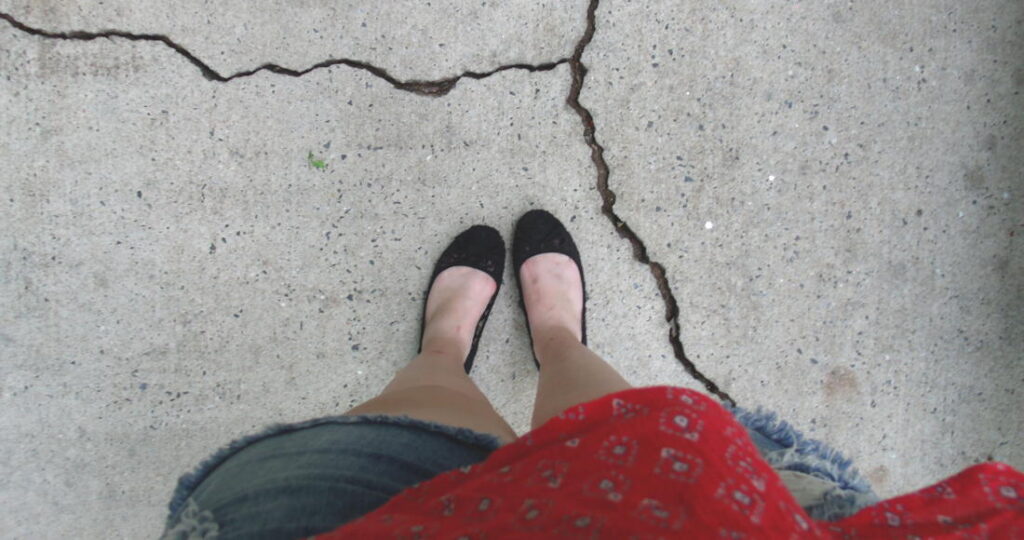
One day a person with OCD might be walking down the street and see the sidewalk crack. They may briefly think of the old superstitious saying “don’t step on a crack, or …” and avoid the crack just in case. Because, even though it’s silly, who would want to cause harm over something so small, so why not? The problem with OCD is that these brief thoughts are the same as what non-OCD people occasionally get flashing through their mind, but in the case of OCD it does not go away, and instead grows stronger over time, one gives in and does the compulsion (i.e., avoiding the crack). While this might seem like a cute quirk, obsessions eventually consume every second of the sufferers day. What begins as avoiding a crack, then might move to avoiding any sidewalks, which might then spiral to all roads, and then eventually to not leaving the house. A person may not even be able to watch TV for fear of seeing a sidewalk or someone stepping on one in a TV show. This is how the OCD can spread and impact every aspect of ones life.
So, the superstitious obsessions can latch onto anything from avoiding walking on cracks, to avoiding black cats, being afraid to walk under a ladder, and many other sorts of superstitious behaviors. Certainly some people are prone to superstition or perhaps even take comfort in these rituals, such as the sport team that wins a game after having spaghetti, and then decides to eat spaghetti before every other big game. But with OCD, the thoughts cause great distress, and are all consuming, with the sufferer going to great lengths to avoid the anxiety inducing stimuli.
Thankfully, regardless of the type of OCD, all types of OCD, including superstitious fears, can be effectively treated. People with this sort of OCD should seek out a mental health provider experienced in exposure and ritual prevention (ERP, also referred to as EX/RP).

Scientific References
Abramowitz, J. S., Deacon, B. J., Woods, C. M., & Tolin, D. F. (2004). Association between Protestant religiosity and obsessive-compulsive symptoms and cognitions. Depression and Anxiety, 20, 70-76.
Antony, M. M., Downie, F., & Swinson, R. P. (1998). Diagnostic issues and epidemiology in obsessive–compulsive disorder. In R. P. Swinson, M. M. Antony, S. S. Rachman, M. A. Richter, R. P. Swinson, M. M. Antony, M. A. Richter (Eds.), Obsessive-compulsive disorder: Theory, research, and treatment (pp. 3-32). New York, NY: The Guilford Press.
Brugger, P., & Viaud-Delmon, I. (2010). Superstitiousness in obsessive-compulsive disorder. Dialogues in Clinical Neuroscience, 12(2), 250–254.
Deacon, B. & Nelson, E. A. (2008). On the Nature and Treatment of Scrupulosity. Pragmatic Case Studies in Psychotherapy, 4(2), 39-53.
Elliott, C., & Radomsky, A. (2008). Blasphemous obsessions in obsessive-compulsive disorder (OCD): Collision or cooperation between psychology and spirituality? Counselling and Spirituality/Counseling et spiritualité, 27(1), 51-69.
Foa, E. B., & Kozak, M. J. (1995). DSM IV field-trial: Obsessive compulsive disorder. American Journal of Psychiatry, 152, 90-96.
Himle, J. A., Chatters, L. M., Taylor, R. J., & Nguyen, A. (2011). The relationship between obsessive-compulsive disorder and religious faith: Clinical characteristics and implications for treatment. Psychology of Religion and Spirituality, 3(4), 241-258.
Miller, C. H., & Hedges, D. W. (2008). Scrupulosity disorder: An overview and introductory analysis. Journal of Anxiety Disorders, 22, 1042-1058.
Millet, K. (2004). Phenomenological and comorbid features associated in obsessive–compulsive disorder: influence of age of onset. Journal of Affective Disorders, 79(1), 241–246.
Olatunji, B. O., Abramowitz, J. S., Williams, N. L., Connolly, K. M., & Lohr, J. M. (2007). Scrupulosity and obsessive-compulsive symptoms: Confirmatory factor analysis and validity of the Penn Inventory of Scrupulosity. Journal of Anxiety Disorders, 21, 771-787.
Sharma, D. D., Kumar, R., & Sharma, R. C. (2006). Starvation in obsessive-compulsive disorder due to scrupulosity. Indian Journal of Psychiatry, 48, 265-266.
Sica, C., Novara, C., & Sanavio, E. (2002). Religiousness and obsessive-compulsive cognitions and symptoms in an Italian population. Behaviour Research and Therapy, 40, 813-823.
Siev, J., Baer, J., & Minichiello, W. E. (2011). Obsessive-compulsive disorder with predominantly scrupulous symptoms: Clinical and religious characteristics. Journal of Clinical Psychology, 67(12), 1188-1196.
The Impact of OCD
How Can the New England OCD Institute Help?
Our group of caring clinicians can offer the Gold Standard in treating OCD, Exposure and Response Prevention (ERP). Reach out to one of our client intake coordinators to learn more about how this may help you!
Lasting Relief
At the New England OCD Institute, our approach is simple: to provide strategies which can be used lifelong. This means that after your initial treatment, we will continue to provide follow-up care, but will also strive for you to be empowered within your own care and life.