
The Four Types of OCD
About Obsessive-Compulsive Disorder
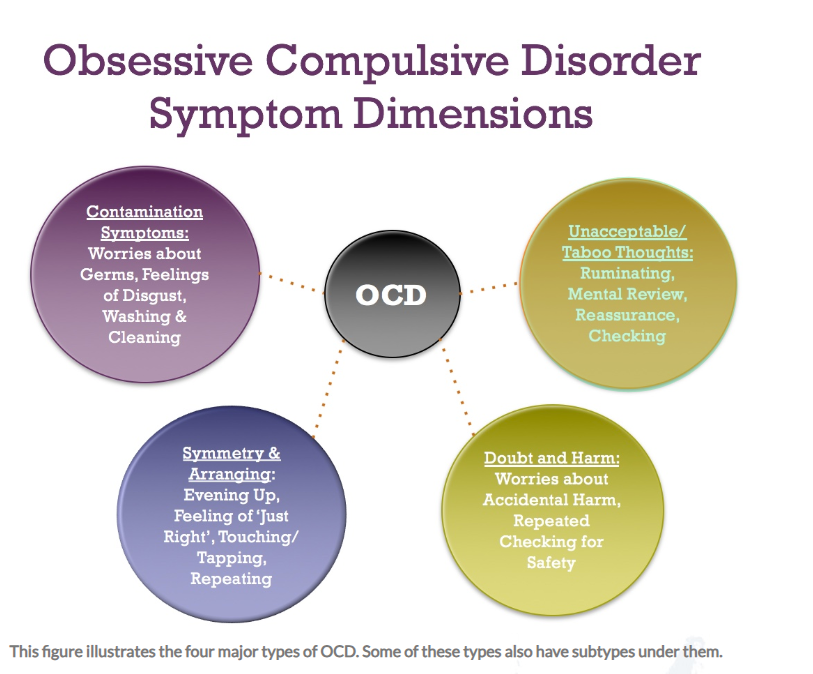
Obsessive-compulsive disorder (OCD) is an anxiety-related condition that causes much suffering and even disability. Researchers have determined that the symptoms of OCD tend to fall into four different categories, called OCD symptom dimensions. Each dimension includes both obsessions and compulsions.
How many types of OCD are there?
OCD can come in dozens of forms – with wildly varying obsessions – but there are four major categories these groupings fall under. Some websites have taken to listing 7 types of OCD, but ultimately they all fit in the 4 types of OCD groupings.
What are the four different types of OCD?
- Contamination & Washing
- Doubt About Accidental Harm & Checking
- Just Right OCD — Symmetry, Arranging, & Counting
- Unacceptable Taboo Thoughts & Mental Rituals
Keep reading to learn about each kind of OCD.
OCD Type 1:
Contamination & Washing
Fear of contamination typically involves excessive concern regarding the threat of illness or disease, the feeling of being physically unclean, or even feelings of being mentally polluted. Feared contaminants are not simply limited to dirt, germs, and viruses, but may include such things as blood, household chemicals, sticky substances or residues, people who appear unclean or unkempt, and various types of insects or animals.
People with this type of OCD may go to great lengths to avoid places and situations associated with feared contaminants (e.g., public bathrooms, etc.) and may involve themselves in many protective rituals, such as disinfecting and sterilizing, throwing “contaminated” objects away, changing clothes frequently, and designating “clean” areas within their home that are off limits to others. If contaminants cannot be avoided, however, individuals will often resort to excessive washing or house cleaning to decontaminate themselves and their possessions. Contact with a feared contaminant often results in feelings of fear, disgust, and general discomfort, and in some cases may result in feelings of responsibility for spreading contamination to others
OCD Type 2:
Doubt About Accidental Harm & Checking
Individuals whose primary obsessions fall within this category typically experience intrusive images, impulses, and fears related to the possibility of unintentionally harming themselves or someone else by means of carelessness or negligence. For example, some of the more common harming fears include the fear of hitting a pedestrian while driving, or the fear of forgetting to turn off the stove before going to bed, thereby leading to the death of a loved one in a house fire. Accompanying the fear of harm is often an excessive feeling of doubt, dread, or uncertainty, as well as a heightened feeling of responsibility. Repetitive checking behaviors are used as a means to neutralize these feelings of dread and uncertainty by ultimately trying to prevent or avert the perceived dangerous consequence; thus, people demonstrating such behaviors have often been referred to as “checkers.”
OCD Type 3:
Just Right OCD — Symmetry, Arranging, & Counting
Perfectionism is a typical symptom of OCD patients who tend to be primarily preoccupied with order, symmetry, and exactness. These individuals tend to engage in compulsive behaviors that include repetitive arranging, organizing, or lining up of objects until certain conditions are met. For example, patients may experience intense discomfort if the objects on their desk are not symmetrically aligned or a certain distance apart from one another. It has been proposed that a common theme in the symmetry and ordering category is a feeling of “incompleteness” which is also associated with compulsive slowness. Individuals with this type of OCD may engage in rituals, such as mental arranging and counting, as well as tapping and touching behaviors. These behaviors are sometimes accompanied by magical thinking &mdasp; i.e., the belief that a thought can cause an event to happen or not (e.g., “If I don’t align the dinner plates, my husband will have a car accident and die on his way home from work”), although studies have shown that there is also a large group of individuals who do not report beliefs of this sort.
OCD Type 4:
Unacceptable Taboo Thoughts & Mental Rituals
The “taboo,” or “unacceptable thoughts,” symptom dimension describes people with unwanted obsessions that are often of a religious, violent, or sexual nature. This group is often referred to as “pure obsessional” due to their lack of overt rituals. However, it is these individuals tend to engage in covert rituals, such as mental compulsions and excessive reassurance-seeking. This symptom dimension captures individuals who have intrusive thoughts that severely violate their morals or values. Examples include thoughts of sexually molesting children, blasphemous thoughts about religious figures, and impulses to do violent things, such as to push pedestrians into oncoming traffic. People with these thoughts typically are not violent, nor do they act on their urges or impulses; however, because people with OCD often believe their thoughts are dangerous and overly important, they devote a large amount of their mental effort in attempts to suppress them.
Other attempts to control intrusive thoughts include mental ritualization (e.g., arguing with oneself over the morality of one’s character), neutralizing (e.g., mentally “cancelling out” bad thoughts by replacing them with good thoughts, engaging in excessive prayer or confession), and performing some form of checking (e.g., reviewing one’s behaviors, seeking reassurance from others, etc.) Avoidance of known triggers is also especially common in this group. For example, sufferers may make excuses to avoid childcare responsibilities or religious ceremonies that might trigger unwanted thoughts. People with unacceptable thoughts may suffer with more severe obsessions than those with other forms of OCD.
Scientific References
Abramowitz, J. S., Deacon, B. J., Olatunji, B. O., Wheaton, M. G., Berman, N. C., Losardo, D., Timpano, K. R., McGrath, P. B., Riemann, B. C., Adams, T., Björgvinsson, T., Storch, E. A., & Hale, L. R. (2010). Assessment of obsessive-compulsive symptom dimensions: Development and evaluation of the Dimensional Obsessive-Compulsive Scale. Psychological Assessment, 22(1), 180–198. doi: 10.1037/a0018260
Williams, M. T., Farris, S. G., Turkheimer, E., Franklin, M. E., Simpson, H. B., Liebowitz, M., & Foa, E. B. (2014). The Impact of Symptom Dimensions on Outcomes for Exposure and Ritual Prevention Therapy for Obsessive-Compulsive Disorder. Journal of Anxiety Disorders, 28 (6), 553-558. doi: 10.1016/j.janxdis.2014.06.001
The Impact of OCD
How Can BWC Help?
Our group of caring clinicians can offer the Gold Standard in treating OCD, Exposure and Response Prevention (ERP). Reach out to one of our client intake coordinators to learn more about how this may help you!
Lasting Relief
At the Behavioral Wellness Clinic, our approach is simple: to provide strategies which can be used lifelong. This means that after your initial treatment, we will continue to provide follow-up care, but will also strive for you to be empowered within your own care and life.