
Symptoms of OCD
Obsessive-Compulsive Disorder
Obsessive-compulsive disorder (OCD) is a serious mental disorder that involves distressing obsessions and repetitive compulsions. The average age of onset is 19.5, but most people can remember having some symptoms in childhood. Most people with OCD find that it interferes with work, school, well-being, and relationships.
About Obsessions
Obsessions are ideas, thoughts, impulses, or images that keep coming back. They are not enjoyable, rather obsessions are unwanted and upsetting, causing severe anxiety or distress. The content of these obsessions are sometimes grouped into four major areas, including:
- Doubts (fears of accidentally harming others or being responsible for harm)
- Contamination (fears of being dirty or getting sick)
- Unacceptable taboo thoughts (fears of doing something immoral)
- Symmetry & Exactness (things not feeling just right)
Everyone has normal worries about these sort of things from time to time. What separates OCD obsessions from normal obsessions are the frequency, intensity, and distress. People with OCD want to make the obsessions go away, but the thoughts just keep coming back.
Classifying Obsessions
Researchers have described two types of obsessions: autogenous and reactive. Autogenous obsessions are experienced as involuntary, guilt-provoking thoughts without an identifiable trigger (e.g., spontaneous unacceptable sexual thoughts). Reactive obsessions are caused by external events and tend to be related to concerns about contamination, accidents (e.g., seeing glass on the floor leads to thoughts of being responsible for someone being injured), and/or a need for perfection. There are many types of OCD that fall within each of these two categories, as shown on the next page, the four kinds of OCD.
About Compulsions
People with OCD engage in repeated behaviors or thoughts, known as compulsions, to try to make the obsessions go away and make themselves feel safer. Compulsions are rituals that the person believes reduce the risk of the obsessions coming true, or at least reduce the anxiety they produce. Compulsions can come in many forms:
- Physical rituals (like washing, or checking the faucet, repeating, or arranging)
- Mental rituals (like praying or mental counting)
- Somatic rituals (like checking the body for signs of illness or sexual arousal)
- Reassurance-seeking (like asking other people if “I’m ok” or finding answers online)
One problem is that the compulsions are not useful, as they do not prevent the feared consequence or are so clearly excessive that they cause other problems. Also, the more the sufferer does compulsions, over time, the stronger the OCD becomes. Compulsions or rituals take up so much time that they get in the way of other important things in life.
OCD Biology: Brain on Fire!
The following PET scan image illustrates overactive brain metabolism in OCD. Specific brain circuits involving certain regions are thought to mediate obsessive-compulsive disorder symptoms.
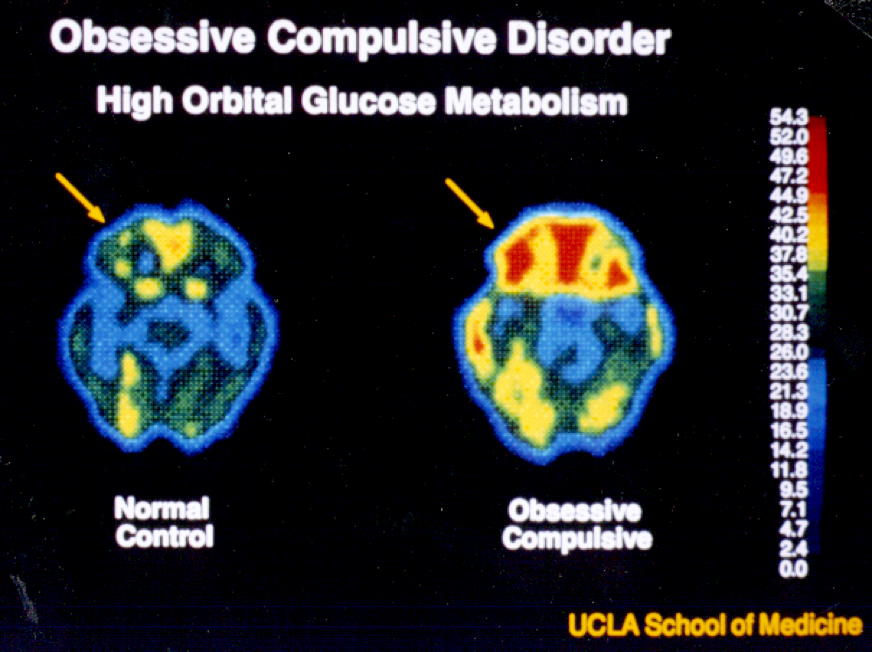
Baxter, L. R., J. M. Schwartz, K. S Bergman, et al. 1992. Caudate glucose metabolic rate changes with both drug and behavior therapy for obsessive-compulsive disorder. In Archives of General Psychiatry 49:681-689.
The Impact of OCD
How Can BWC Help?
Our group of caring clinicians can offer the Gold Standard in treating OCD, Exposure and Response Prevention (ERP). Reach out to one of our client intake coordinators to learn more about how this may help you!
Lasting Relief
At the Behavioral Wellness Clinic, our approach is simple: to provide strategies which can be used lifelong. This means that after your initial treatment, we will continue to provide follow-up care, but will also strive for you to be empowered within your own care and life.