
Taboo Categories OCD
The Most Challenging Forms of Obsessive-Compulsive Disorder
Obsessive-compulsive disorder (OCD) is an anxiety-related condition that causes much suffering and even disability. Researchers have determined that the symptoms of OCD tend to fall into four different OCD categories, called OCD symptom dimensions. Each dimension includes both unrelenting obsessions and repetitive compulsions.
One of these categories is called Unacceptable or Taboo Thoughts in OCD. This symptom dimension captures people who have intrusive thoughts that severely violate their morals or values. Research also shows some connection between this symptom dimension and people who are obsessively worried about their physical or mental health, perhaps due to feelings of shame that are especially intense around each of these kinds of OCD.
Taboo Types are Primarily Obsessional
This group of OCD sufferers have been referred to as “primarily obsessional”, “pure obsessional”, or “pure o” due to the lack of obvious rituals. However, people with this type of OCD perform hidden compulsions, such as elaborate mental ruminations and excessive reassurance-seeking. Among people with taboo obsessions, over time, OCD worries may shift between these different taboo categories. Clinical research shows that, on average, people with these types of OCD are more distressed than people with other forms of OCD, such as washing or arranging, and treatment is more challenging or may take longer.
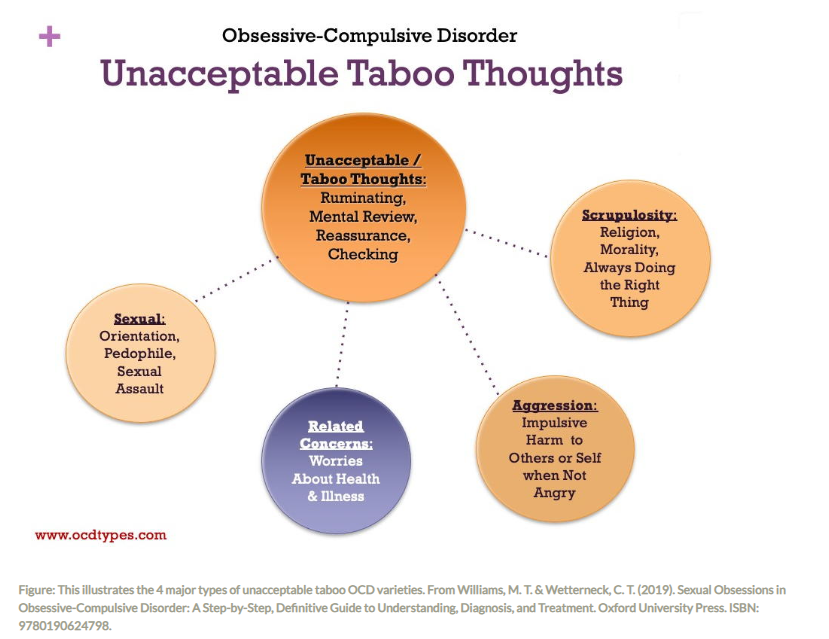
What are the four different types of taboo OCD?
Taboo OCD Type 1: Aggression & Violence
People with this kind of OCD have intrusive thoughts or impulses to do violent things, such as to push pedestrians into oncoming traffic or to stab a family member with a steak knife. People with these thoughts typically are not violent, nor do they act on their urges, but they feel very frightened that they might. As a result they go to extreme lengths to make sure those around them are safe, which may mean avoiding peple they worry are vulnerable or objects that could be used to harm others. It is not uncommon for women to develop postpartum OCD, where they might have unwanted thoughts about hurting their babies.
Taboo OCD Type 2: Scrupulosity

Scrupulosity describes people with unwanted obsessions that are often of a moral or religious nature. Examples include worries about having committed a sin or breaking a religious rule, blasphemous thoughts about religious figures, or fear that one is falling short morally. People with this kind of OCD may try to control intrusive thoughts with mental ritualization (e.g., arguing with oneself over the morality of one’s character) or neutralizing strategies (e.g., engaging in excessive prayer or confession). Sufferers may think that their rituals are making them a better person or more devout, but generally the OCD interferes with carrying out one’s faith.
Taboo OCD Type 3: Sexual
The Sexual category describes people with unwanted obsessions of sexual nature. These are not sexual fantasies, but worries that the sufferer will discover sexual tendencies that are contrary to their nature, such as an attraction to children, animals, or to people who are incongruent with their sexual orientation. Further, people with these obsessions worry they may eventually act out on their fears. This may include anxieties about sexually molesting children, having a sexual relationship with someone of the same sex if they are heterosexual or of a different sex if they are gay or lesbian. There are also examples of people having doubts about their gender identity due to OCD. People with sexual OCD may also worry about behaving in a sexually inappropriate way, for exampling seducing a married colleague, sexually harassing a subordinate employee, or even committing a violent sexual crime.
Taboo OCD Type 4: Health Anxiety
Health anxiety is when people have excessive anxieties about their health or wellbeing, and worry that something may be seriously wrong with them. People with this kind of OCD may also worry about their mental health, for example they may have concerns they are psychotic, that they are not accurately perceiving reality, or they fear that they might injure or kill themselves. Health anxieties may not seem to fit with unacceptable taboo thoughts in OCD, but some research indicates that these symptoms share a relationship, perhaps due strong feelings of shame and the tendency to engage in covert checking of their mental or physical state.
Treatment for Taboo Types of OCD
The same treatment used for other forms of OCD is effective for unacceptable taboo forms of OCD, which is Exposure and Response Prevention (ERP). The main difference is that because of the social stigma around these forms of OCD, more experience and skill on the part of the provider is necessary to prevent misdiagnosis or inappropriate treatment. Some examples of treatment errors surrounding this type of OCD appear below.
Major Clinician Errors
- Mistaking fears of stabbing one’s wife as an unconscious expression of marital hostility — this led to serious relationship problems
- Recommending that a straight man with fears about sexual orientation go to a gay bar to experiment with being with other men — he was subsequently raped at the bar while drunk
- Reporting a mother to child protective services because of her sexually intrusive thoughts about her daughter — she was barred from seeing her child
- Confusing religious obsessions with psychosis — the person was mistakenly admitted to a psychiatric hospital with schizophrenic patients
- Mistaking fears about self-harm in OCD with suicidal ideation in major depressive disorder — the person was put on suicide watch
In each of these cases, more harm was done because the OCD was missed by professionals without enough training or experience around OCD, and tragically diagnosed as something else. This is why expert treatment is critical for those with these forms of the disorder.
In the News
Beltran, I. (Feb 24, 2021). Intrusive Thoughts Normal or Not? Why People Have It And How To Cope. The Science Times.
Scientific References
Williams, M. T., Mugno, B., Franklin, M. E., & Faber, S. (2013). Symptom Dimensions in Obsessive-Compulsive Disorder: Phenomenology and Treatment with Exposure and Ritual Prevention. Psychopathology, 46, 365-376. doi: 10.1159/000348582
Williams, M.T., Elstein, J., Buckner, E., Abelson, J., & Himle, J. (2012). Symptom Dimensions in Two Samples of African Americans with Obsessive-Compulsive Disorder. Journal of Obsessive-Compulsive & Related Disorders, 1(3), 145-152. doi: 10.1016/j.jocrd.2012.03.004
Williams, M. T., Farris, S. G., Turkheimer, E., Pinto, A., Ozanick, K., Franklin, M. E., Simpson, H. B., Liebowitz, M., & Foa, E. B. (2011). Myth of the Pure Obsessional Type in Obsessive-Compulsive Disorder. Depression & Anxiety, 28, 6, 495-500.
The Impact of OCD
How Can BWC Help?
Our group of caring clinicians can offer the Gold Standard in treating OCD, Exposure and Response Prevention (ERP). Reach out to one of our client intake coordinators to learn more about how this may help you!
Lasting Relief
At the Behavioral Wellness Clinic, our approach is simple: to provide strategies which can be used lifelong. This means that after your initial treatment, we will continue to provide follow-up care, but will also strive for you to be empowered within your own care and life.